
Authenticity & AI Detection
January 16, 2026
CES 2026: What the AI Hype Still Misses About Image Authenticity
⇥ QUICK READ
<div class="hs-cta-embed hs-cta-simple-placeholder hs-cta-embed-116492913348"
style="max-width:100%; max-height:100%; width:170px;height:520px" data-hubspot-wrapper-cta-id="116492913348">
<a href="https://cta-eu1.hubspot.com/web-interactives/public/v1/track/redirect?encryptedPayload=AVxigLLzYHGtMYDgEXfYVUgSiXwccJLh5h3CwupigPP41t9C%2F%2FVGLQzQo6QfRZvkRixD3Gg8ORSe2kvWQLaQzNRj9oZIrDcCMVB4toZwj2GQNTwKFbP2xz0s6ZR7VIxerClVpKKlA56vLkY0Y6X9egfFZQbDbpD6n%2B2d3BdOYnLSFlg5cgNHHA%2FlABqhYebal4LFvJL9LUdJW%2B8x53h%2F7XQlGL9Y5bu%2BdF%2FA5MM6xEWx4QL3aw%3D%3D&webInteractiveContentId=116492913348&portalId=4144962" target="_blank" rel="noopener" crossorigin="anonymous">
<img alt="Do you know which laws apply to you?" loading="lazy" src="https://hubspot-no-cache-eu1-prod.s3.amazonaws.com/cta/default/4144962/interactive-116492913348.png" style="height: 100%; width: 100%; object-fit: fill"
onerror="this.style.display='none'" />
</a>
</div>
Share this article


Subscribe to the blog!
I subscribeCES 2026 once again captured massive global media attention, with artificial intelligence dominating conversations across keynotes, booths, demos, and headlines. From generative models to automation and safety systems, AI was clearly the central narrative of the show.
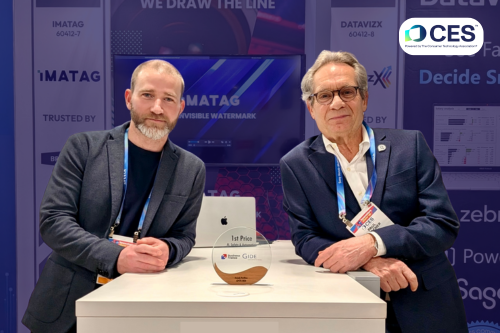
Imatag was very much part of that momentum. Throughout the event, our work on image trust and safety generated significant interest, reflected in widespread media coverage and recognition on the CES stage, including being awarded 1st prize in the AI, Safety & Automation category at the CES 2026 pitch contest.
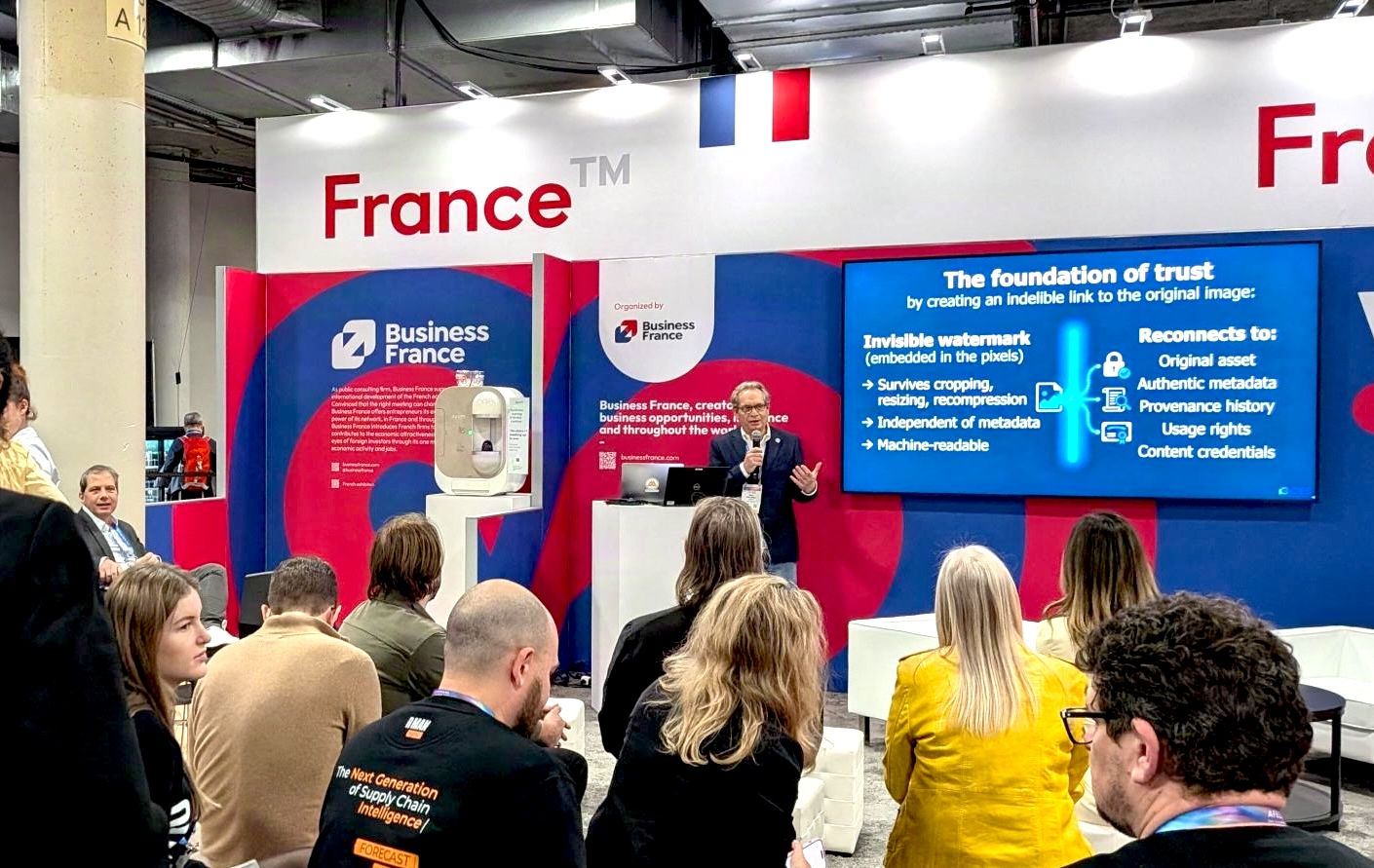
Beyond the spotlight, CES also offered a valuable vantage point on how the image ecosystem is evolving, and where important blind spots remain. Instead of adding yet another take on CES innovation trends, this article shares our observations on how image authenticity and protection are being addressed — or overlooked — in today’s AI-driven landscape.
1. AI Everywhere, Trust Almost Nowhere
Walking the CES floor, one contrast stood out clearly: while AI was omnipresent, conversations around trust were marginal.
Content generation dominated discussions, demos, and messaging. By comparison, topics such as image authenticity, provenance, and verification standards like C2PA were rarely addressed. In practice, Imatag was among the very few companies actively engaging in conversations about what C2PA is, how it works, and why it matters. On several occasions during CES, companies actively looking for C2PA or authenticity solutions approached us because we were the only visible actor addressing these questions at the event.
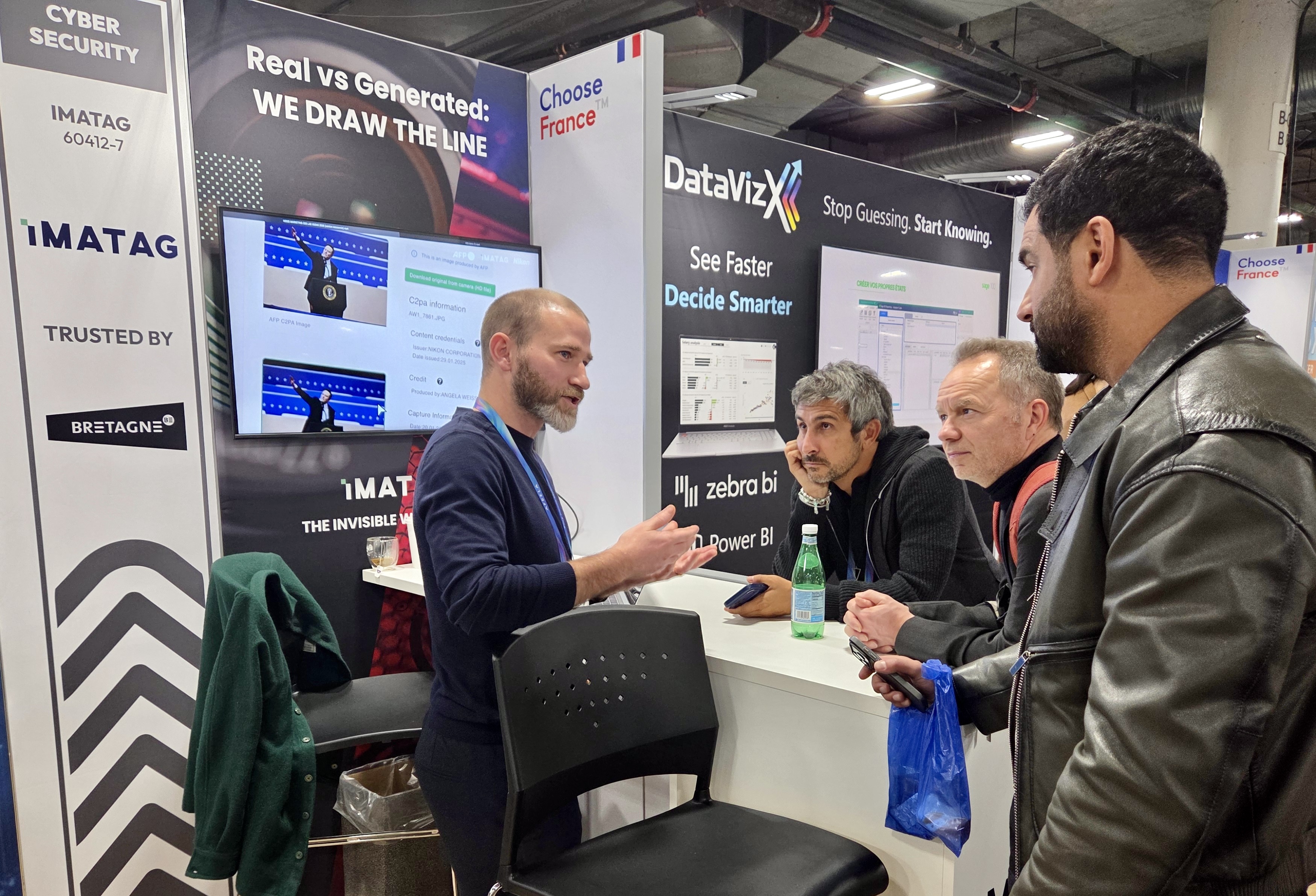
This reveals a structural imbalance. The market is currently optimized for creating more content, faster, not for explaining where that content comes from or why it should be trusted. Questions around origin, traceability, and trust are still treated as secondary, not because they are unimportant, but because, seemingly, the consequences of ignoring them are not immediate.
Yet trust gaps do not disappear over time; they accumulate. And when they surface, they tend to do so with profound consequences.
2. C2PA Through the Consumer Lens: A Perception Problem
One of the most telling observations from CES did not come from technology demos, but from how consumers interpret them.
From a mainstream consumer perspective, the Content Credentials (CR) logo is widely misunderstood. It is frequently confused with an “AI-generated” label and, in many cases, interpreted as a signal that an image was created by AI rather than as proof that it is authentic.
This creates a paradox. The very mechanism designed to reinforce trust in real content can, without proper context, end up producing the opposite effect.
The issue is neither a lack of industry adoption nor a question of technical robustness. It is a gap in pedagogy and perception, a mismatch between the intent behind authenticity standards and the way they are read by the public.

Without clear education around provenance, and when standards are poorly implemented, they risk reinforcing skepticism instead of reducing it. This highlights an essential point: the challenge of trust is not purely technological. It is also cognitive and cultural.
3. Protecting Copyright in AI-Generated Content
Another signal that stood out at CES was the growing interest among AI companies in protecting the copyright of AI-generated content. This is a relatively new shift, and one that can be misunderstood.
The motivation is not purely economic. It reflects an implicit recognition that even in generative AI, there is a human creative process upstream. Prompts, artistic direction, aesthetic choices, data selection, and intent all shape the final output.
Even when an image is generated by a machine, the originality often lies in the human decisions that shape the generation. The system produces the output, but the creative value worth protecting remains human.
4. AI Regulation: Not Ignorance, but Organized Indifference
When it comes to regulation, the situation observed at CES is less about lack of awareness and more about deliberate deprioritization. Across regions, regulatory frameworks already exist or are taking shape, from the EU’s AI Act to emerging rules in the US and other markets. Yet for many AI companies, these frameworks are simply not a priority today.
For the European actors we met, the European AI Act, is not a pressing concern. Obligations around labeling, transparency, and traceability are seen as future problems. Compliance is perceived as friction in a race driven by speed and innovation.
This results in a form of temporary “organized anarchy,” where the ability to build quickly outweighs the need to explain clearly.
That imbalance is unlikely to hold. Regulation will not replace innovation, but it will increasingly define the conditions under which it operates.
Companies that anticipate this shift structurally, rather than respond to it defensively, will be better positioned as the market matures.

5. Synthetic Images: A New Kind of Usage
Another important evolution observed at CES concerns how synthetic images are being used.
Increasingly, images are no longer created to be seen by humans. They are generated to serve machines. In many cases, their role is operational rather than visual.
A clear example comes from the automotive sector, where companies generate synthetic images of tired or distracted drivers to train detection systems. These scenarios are difficult, costly, or unsafe to capture at scale in real conditions. Synthetic images make that training possible.
A second example comes from defense and security use cases. Some systems are trained on synthetic images of aircraft or military equipment that are rarely accessible, classified, or simply unavailable in real datasets. The image is not a representation of reality, but a means to enable detection and analysis.
In these contexts, images are tools. This shift moves the discussion away from “real versus fake” and toward a more relevant question: what was this image created to do?
6. Public Trust and Private Protection: Two Sides of the Same Challenge
Despite the attention around authenticity and misinformation, one reality remains unchanged: companies still have a strong and immediate need to protect their images.
Concerns around unauthorized redistribution, internal leaks, and loss of control over visual assets continue to drive concrete demand. These are not theoretical or ethical debates, but operational risks that companies deal with every day.
This highlights a simple point. The image economy is shaped not only by public trust, but by responsibility, liability, and control. Protecting images internally and building trust externally are not competing priorities. They address the same underlying challenge from different angles.
Our Conclusion: Turning Blind Spots into Infrastructure
Taken together, these observations from CES 2026 point to a common issue. Images are central to AI systems, public trust, and business risk, yet the mechanisms to secure their origin, integrity, and usage remain underdeveloped.
This is precisely where Imatag’s technology fits. By embedding provenance, authenticity, and protection directly into images, Imatag addresses challenges that the market is only beginning to confront, from trust at scale to regulatory readiness and operational control.

Want to "see" an Invisible Watermark?
Learn more about IMATAG's solution to insert invisible watermarks in your visual content.
Book a demo
Mathieu Desoubeaux
Digital contents protection & computer science, passionate about photography and digital content. His past experiences in content identification within Orange Telecom Group and Inria Lab gave him a good awareness regarding the merging of scientific and economical worlds.

These articles may also interest you
Authenticity & AI Detection
July 1, 2026
Authenticating reality: why marking the real matters more than marking the synthetic

Authenticity & AI Detection
March 10, 2026
Why Image Authenticity Must Be at the Core of Digital Asset Management
Authenticity & AI Detection
February 17, 2026
Image Authenticity Verification Methods: What Works Today
Subscribe to the blog!
By submitting this form, I agree to Imatag Privacy Policy.
